Elephants live in parts of Africa and Asia. They eat only plants, including grasses, leaves, and fruit that they collect with the trunk. They live in small family groups, or herds, led by adult females.
DNA in the cell nucleus carries a genetic code, which consists of sequences of adenine (A), thymine (T), guanine (G), and cytosine (C) (Figure 1). RNA, which contains uracil (U) instead of thymine, carries the code to protein-making sites in the cell. To make RNA, DNA pairs its bases with those of the “free” nucleotides (Figure 2). Messenger RNA (mRNA) then travels to the ribosomes in the cell cytoplasm, where protein synthesis occurs (Figure 3). The base triplets of transfer RNA (tRNA) pair with those of mRNA and at the same time deposit their amino acids on the growing protein chain. Finally, the synthesized protein is released to perform its task in the cell or elsewhere in the body.
Iguassu Falls, “an ocean plunging into an abyss” on the border between Argentina and Brazil. The waterfall system consists of 275 falls along 2.7 kilometers (1.67 miles) of the Iguassu River. Position is at latitude (DMS): 25° 40' 60 S, longitude (DMS): 54° 25' 60 W . Some of the individual falls are up to 82 meters (269 ft) in height, though the majority are about 64 metres (210 ft). The Garganta del Diablo (Devil's Throat; Garganta do Diabo in Portuguese), a U-shaped 82-meter-high, 150-meter-wide and 700-meter-long (490 by 2300 feet) cliff, is the most impressive of all, and marks the border between Argentina and Brazil. Two thirds of the falls are within Argentine territory. [1] About 900 metres of the 2.7-kilometer length does not have water flowing over it. The edge of the basalt cap recedes only 3 mm per year. The water of the lower Iguassu collects in a canyon that drains into the Parana River in Argentina, shortly downstream from the Itaipu dam.
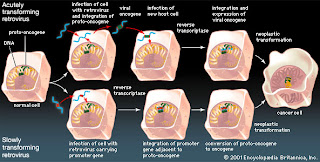
Retro viral insertion can convert a proto-oncogene, integral to the control of cell division, into an oncogene, the agent responsible for transforming a healthy cell into a cancer cell. An acutely transforming retrovirus (shown at top), which produces tumours within weeks of infection, incorporates genetic material from a host cell into its own genome upon infection, forming a viral oncogene. When the viral oncogene infects another cell, an enzyme called reverse transcriptase copies the single-stranded genetic material into double-stranded DNA, which is then integrated into the cellular genome. A slowly transforming retrovirus (shown at bottom), which requires months to elicit tumour growth, does not disrupt cellular function through the insertion of a viral oncogene. Rather, it carries a promotor gene that is integrated into the cellular genome of the host cell next to or within a proto-oncogene, allowing conversion of the proto-oncogene to an oncogene.

Comments